
Causes of P008E trouble code
From my time under the hood, here are the most common culprits behind a P008E code:
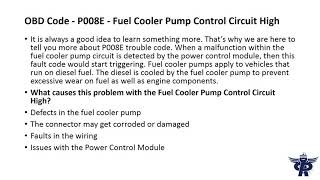
- A fuel cooler pump that’s gone bad-it’s supposed to move fuel through the cooler, and if it quits or starts acting up, the circuit will complain.
- Connectors that are corroded, dirty, or just plain loose. It doesn’t take much-one crusty pin or a half-plugged connection can throw the voltage off.
- Wiring that’s seen better days. Maybe it’s been rubbing against something, pinched by a bracket, or even cooked by exhaust heat. Any of that will cause electrical headaches.
- The PCM itself can be to blame, but that’s honestly pretty rare. Usually, it’s after water’s gotten into the electronics or there’s been a nasty voltage spike.
In my experience, if you start by checking the pump and the wiring, you’ll find the problem nine times out of ten. Don’t overlook the simple stuff.
Symptoms of obd code P008E
When a diesel rolls in with a P008E, here’s what I tell folks to watch out for:
- Weak acceleration-if your truck just feels tired or it struggles to get moving, this might be why.
- Surging or a bouncing idle. If the revs are hunting up and down, don’t just chalk it up to bad fuel.
- The check engine light-that’s a given. You’re not getting away from that one.
- Fuel economy that’s suddenly in the tank. If you’re at the pump more often, that’s a clue the system isn’t running right.
- Noises from the fuel cooler pump. Sometimes it’ll whine, sometimes it’ll sound like a little dog barking under the hood. Either way, it’s not normal.
These signs can be subtle at first. If anything feels off, don’t wait-catching it early is always cheaper and easier.

Diagnosis steps for P008E engine code
Let me walk you through how I’d chase down a P008E:
- First step: track down every part in the fuel cooler pump circuit. That means the pump, the cooler, any reservoirs, and the PCM.
- I always start with a good old-fashioned look-over. I’m hunting for chewed-up wires, loose or rusty connectors, melted insulation, or anything that looks out of place. Don’t forget to peek for coolant leaks or low fluids around the cooler-it’s easy to miss.
- If everything looks clean, I grab my multimeter and start checking voltage at the pump connector. If you’ve got power but the pump’s dead, odds are it’s time for a new pump.
- Pump making a racket? That’s another giveaway it’s on the way out.
- No power or no ground? Now we’re following the wiring, checking for continuity with the battery unhooked. Any resistance or an open circuit means you’ve found a break or a bad connector.
- If you’ve checked all that and still don’t have an answer, only then do I turn my attention to the PCM. Honestly, that’s the last stop-unless your truck has a history of computer issues or there’s a TSB out there.
Here’s a pro-tip from the garage: always have someone help when you’re poking around with the engine running, and double-check each step before moving on. Saves a lot of headaches.
Common Mistakes when addressing dtc P008E
A classic mistake I see is jumping straight to a new fuel cooler pump-folks drop a bunch of cash before even glancing at the wiring or connectors. Sometimes all you need is a little contact cleaner or to snug up a plug.
- Skipping TSBs is another big one. Sometimes the fix is well-known in the dealer network, and you could save yourself a wild goose chase.
- Guessing instead of testing. If you’re not checking for voltage or continuity before swapping parts, you’re just rolling the dice with your wallet.
- Overlooking coolant leaks or low levels. If the cooler isn’t working right, you might miss a bigger issue hiding underneath.
Don’t get fancy before you’ve covered the basics-a careful inspection up front pays off every time.

Seriousness of obd2 code P008E
Let me be blunt-this isn’t the kind of problem you want to put off. Hot fuel is bad news for any diesel; you’re risking premature wear on your fuel system, damage to injectors, and even internal engine problems if you let it go. I’ve seen trucks go from running fine to dead on the side of the road in no time when this gets ignored. You could be looking at a fried fuel pump, trashed injectors, or worse. Bottom line: sort it out before you end up with a much bigger bill and a lot more downtime.
Repair solutions for P008E
Here’s what usually gets the job done, based on what I see in the bay and the official guides:
- Swap out the fuel cooler pump if it’s seized, noisy, or just not doing its job.
- Clean up or replace any connectors that have corrosion or don’t fit snugly.
- Fix or replace any wiring that’s been damaged-especially if you find melted spots, bare wires, or brittle insulation.
- In the rare case the PCM is toast, reprogramming or replacing it is the final step-but only after you’ve ruled out everything else.
Always check the service info for your specific model, and don’t forget to clear the code and take it for a drive after. If the code comes back, something’s still not right.


Conclusion
Here’s the takeaway: P008E means your diesel’s got an issue with the fuel cooler pump control circuit, and ignoring it is asking for trouble. My advice? Start with a sharp-eyed inspection of the pump, wiring, and connectors. Those are the usual suspects and can often be fixed without breaking the bank. Don’t shrug off the check engine light or any weird symptoms-catching this early is the best way to avoid a world of hurt down the line. Stick to a methodical diagnostic process, fix the root cause, and you’ll keep your diesel humming along for the long haul.
 4515
4515 6 minutes of reading