
Causes of dtc P0249
From my time under the hood, I can tell you the culprits behind a P0249 code are almost always electrical. Here’s what I see most often:
- A break in the ground circuit between the boost control solenoid 'B' and the PCM.
- A break in the power supply circuit to the solenoid.
- A short to ground in the solenoid’s power supply line.
- A bad boost control solenoid 'B'-not common, but it happens.
- On rare occasions, the PCM itself fails, but honestly, that’s hardly ever the issue.
Bottom line: nine times out of ten, you’re dealing with a wiring or connector fault, not a busted PCM or turbo hardware.
Symptoms of P0249 engine code
When this code lights up, you’ll notice a few telltale signs. The check engine light is the obvious one, and sometimes a warning message will show up on your dashboard. But the real giveaway? Your car just won’t have the same punch when you hit the gas. That loss of power-especially during acceleration-is a dead giveaway. Sometimes that’s all you’ll notice, but don’t ignore it. It’s your car’s way of telling you something’s off.

Diagnosis and obd2 code P0249
Here’s how I tackle a P0249 code in the shop, step by step:
- I always start by checking for Technical Service Bulletins (TSBs) for your specific ride. Sometimes there’s an easy fix waiting in the dealership’s playbook.
- Next, I hunt down the boost control solenoid 'B.' You’ll usually find it hanging out near the turbo or along the intake piping.
- Then it’s time for a close look at the wiring and connectors. I’m hunting for frayed wires, melted insulation, corrosion (if you see green, that’s a problem), or anything that looks loose. Don’t skip checking both ends of the connector-issues love to hide there.
- If I see corrosion or grime, out comes the electrical contact cleaner and a plastic brush. Once everything’s clean and dry, I hit the terminals with a dab of dielectric grease to keep moisture out.
- After cleaning things up, I’ll clear the code with a scan tool and see if it comes back on a test drive. If not, the problem was just a bad connection-a simple fix.
- If the code returns, it’s time to test the solenoid. I unplug the harness and use a digital voltmeter to check resistance across the two pins. You want to see a value within spec-not infinite (open circuit) or zero (shorted). I always double-check against the service manual for the correct number.
- If the solenoid checks out, I check for 12 volts at the power wire with the ignition on. No power? Time to trace that wire back to the PCM or relay, looking for breaks or shorts.
- I’ll also test the ground with a test light-hooking one end to battery positive and the other to the solenoid’s ground wire. If the light stays dark when the solenoid should be energized, you’ve got a bad ground.
- Finally, I wiggle the harness while watching the test light or voltmeter for any flickers-intermittent faults love to show up when you move things around.
If the wiring and solenoid check out but the code just won’t quit, only then do I start to consider the PCM as the problem. But honestly, that’s a rare bird.
Common Mistakes with P0249
A classic mistake I see? People throw parts at the problem-replacing the solenoid or even the PCM-without giving the wiring and connectors a proper once-over. Another one: folks overlook the terminals, not realizing corrosion can be sneaky and cause all sorts of headaches. Skipping these basics wastes time and money. Here’s a pro-tip from the garage: always start with the simple stuff before reaching for your wallet.

Seriousness of P0249 code
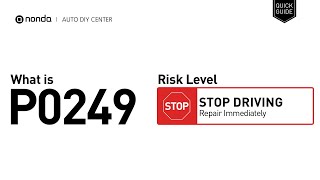
Don’t brush this off. When the boost control circuit isn’t working right, your car can end up with little or no power. That’s not just annoying-it can be downright dangerous if you need to accelerate in a pinch. And if the turbo system isn’t reined in, you could wind up with engine damage, overboost, or a cooked turbo. Things can go south in a hurry if you ignore this one, so get on it sooner rather than later.
Repair steps for obd code P0249
When it comes to fixing a P0249 code, here’s what I’ve seen actually works:
- Patch up or swap out any damaged wiring or connectors at the boost control solenoid 'B.'
- Get all the electrical contacts clean as a whistle, then protect them with a dab of dielectric grease.
- If the solenoid fails a resistance or activation test, replace it with a new one.
- Only in those once-in-a-blue-moon cases should you consider replacing or reprogramming the PCM-and only after ruling out everything else.
Don’t forget to clear the code and take the car for a spin afterwards. If the code stays gone, you’ve nailed it.


Conclusion
To wrap it up, P0249 means your car’s computer isn’t seeing the voltage it expects in the boost control solenoid 'B' circuit. Most of the time, it’s a wiring or connector issue and not some catastrophic failure. You’ve got to get on this quickly, because ignoring it can lead to power loss or even some serious engine or turbo trouble. My advice? Start with the easy stuff-inspect and clean those wires and connectors-before moving on to the solenoid. Don’t procrastinate. The best fix is a step-by-step approach that zeroes in on any electrical gremlins you find. That’s how you’ll keep your car running strong and trouble-free.

 6013
6013 6 minutes of reading