
Causes of P0887 engine code
From experience, the most common reasons for this issue are pretty straightforward. Most often, it’s a faulty relay or a blown fuse that supplies power to the transmission control module. Other times, it’s a wiring issue-like a broken wire or a short in the CAN network. Sometimes, a bad vehicle speed sensor can cause it, or there could be a mechanical problem inside the transmission. In rare situations, the TCM or PCM itself might be faulty, or there could be a programming error. Here’s a quick rundown of what I usually check first:
- Blown fuse or faulty relay supplying power to the TCM
- Damaged or corroded wiring/connectors in the transmission control circuit or CAN bus
- Faulty vehicle speed sensor
- Mechanical failure inside the transmission
- Defective TCM, PCM, or software glitch
Symptoms of P0887 trouble code
If your car has this code, you’ll probably notice some changes in how it drives. Most drivers tell me their transmission starts shifting much rougher than usual, or sometimes won’t shift at all. You might see the traction control or ABS lights come on, and those systems could be disabled. In some cases, the car may go into a limp mode, where it won’t shift out of a certain gear. Here’s what you’re likely to experience:
- Harsh or erratic shifting
- Transmission won’t shift gears
- Traction control and ABS disabled
- Warning lights on the dash (MIL, ABS, traction control)
- Other related trouble codes stored

P0887 diagnosis process
Here’s how I tackle this issue step by step. First, I always start simple: check for any technical service bulletins (TSBs) that match your car’s symptoms and model-sometimes there’s a known fix. Next, I plug in a diagnostic scanner and pull all stored codes and freeze-frame data. I write this down in case the issue is intermittent. Then I clear the codes and take the car for a test drive to see if the code comes back or if the computer goes into readiness mode. If the code returns, I move on to a thorough visual inspection of all wiring and connectors related to the transmission control relay and module. Look for anything burnt, frayed, or corroded. Don’t forget to check the fuse and relay-replace them if they’re bad. After that, I use a digital volt/ohm meter to check for power and ground at the TCM and PCM. If there’s no voltage, I trace back to the relay and fuse. If everything checks out but the code remains, I suspect a problem with the TCM or PCM itself, or possibly a programming issue. It’s best to have someone assist you with the wiring checks, and always make sure to inspect the basics before moving on to deeper diagnostics.
Common mistakes in obd2 code P0887 troubleshooting
One thing I see a lot is folks jumping straight to replacing expensive modules without checking the simple stuff first. Skipping the fuse and relay check is a surefire way to waste money and time. Another common mistake is overlooking wiring issues-sometimes a tiny break or corrosion in a connector is all it takes. Also, ignoring related codes or not checking for TSBs can lead you down the wrong path. Always start with the basics and don’t assume the worst right away.

Seriousness of dtc P0887 in your vehicle
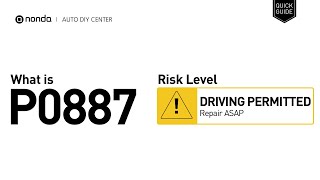
Honestly, this is not something you want to ignore. If the transmission control module isn’t getting proper power, your transmission can act up in ways that are dangerous-like refusing to shift or going into limp mode. You could lose traction control or ABS, which is a serious hazard, especially in bad weather. If left unchecked, you risk damaging the transmission itself, the control modules, or even causing electrical shorts that affect other systems. Things can go south quickly if overlooked, so don’t put this off for later.
Repair steps for P0887 code resolution
When it comes to fixing this issue, here’s what I typically do. First, replace any blown fuses or faulty relays in the transmission control circuit. Repair or replace any damaged wiring or connectors you find during inspection. If a sensor is bad, swap it out. If the TCM or PCM is faulty, it may need to be replaced or reprogrammed, but that’s usually the last resort after all other checks. Always verify the repair by clearing the code and taking the car for a test drive to make sure it doesn’t come back.
Conclusion
To sum it up, P0887 means your transmission control module isn’t getting the right voltage, usually because of a simple electrical issue like a bad relay or fuse. It’s a high-priority problem because it affects not just shifting, but also safety systems like ABS and traction control. The best way to resolve it is to start with the basics-check fuses, relays, and wiring-before considering more complex repairs. Acting quickly and methodically is the most reliable way to get your car back to safe, smooth operation.

 4701
4701 5 minutes of reading