
Causes of obd code P2767
From what I’ve seen in the shop and what the official manuals say, there are a few main reasons why you’d get a p2767:
- Most often the issue is a faulty input/turbine speed sensor itself. These sensors can wear out or fail over time.
- Wiring problems are another big culprit-damaged wires, loose connectors, or corrosion can interrupt the signal.
- In some cases, a failed valve body or electrohydraulic control unit inside the transmission can cause this code.
- Less commonly, the transmission control module (TCM) itself might be at fault, but that’s pretty rare in my experience.
It’s usually one of those first two, so I always start there before moving on to the more complex stuff.
Symptoms of P2767 engine code
If you’re dealing with a P2767 code, here’s what you’ll probably notice while driving:
- The check engine light will almost always come on.
- You might feel the transmission not shifting smoothly, or it could get stuck in one gear-what we call “limp mode.”
- Fuel consumption goes up, so you’ll find yourself filling up more often than usual.
- Sometimes, the car just feels sluggish or unresponsive when you try to accelerate.
These symptoms can make driving a real headache, and they’re not something you want to ignore.

Diagnosis steps for P2767
Here’s how I approach diagnosing a P2767 code, step by step:
- First, I always start by checking for other codes. Sometimes, another issue can trigger this one, so it’s good to get the full picture.
- Next, I do a visual inspection of the wiring and connectors going to the input/turbine speed sensor B. Look for any obvious damage, loose plugs, or corrosion. It’s best to have someone wiggle the wiring while you watch for changes.
- If everything looks good, I’ll use a multimeter to check for continuity in the wires between the sensor and the PCM. No continuity means you’ve got a break somewhere.
- Then, I test the sensor itself. Most sensors can be checked for resistance with a multimeter-compare your reading to the specs in the repair manual. If it’s way off, the sensor is likely bad.
- If the sensor and wiring both check out, I’ll move on to more advanced tests, like checking the valve body or the TCM, but honestly, those are less common causes.
Don’t forget to double-check the sensor’s mounting and make sure it’s clean and properly seated before replacing anything. Sometimes a simple reseat does the trick.
Common Mistakes with obd2 code P2767
I’ve seen a few common mistakes when folks try to tackle this code:
- Jumping straight to replacing the sensor without checking the wiring first. That’s a surefire way to waste money if the real problem is a broken wire or bad connector.
- Ignoring the possibility of corrosion at the connectors-this is easy to miss but can cause all sorts of headaches.
- Not checking for related codes that might point to a bigger issue in the transmission or PCM.
- Overlooking the need to use the correct specs for resistance or voltage checks. Always use the data for your specific vehicle.
Take your time with the basics before moving on to the expensive parts.

Seriousness of P2767 code
This isn’t something you want to put off. When the input/turbine speed sensor B isn’t working, your transmission can’t shift properly, which can leave you stuck in limp mode or unable to accelerate safely. That’s a serious hazard, especially if you’re out on the highway. Plus, running the car like this can lead to increased fuel consumption and, over time, can cause damage to the transmission itself, the valve body, or even the control modules. Honestly, things can go south quickly if you ignore this, so it’s best to get it checked out right away.
Repair solutions for P2767 trouble code
Here’s what usually fixes a P2767 code, based on what I see in the field and what the manuals recommend:
- Replacing the faulty input/turbine speed sensor B is the most common repair. Make sure to use the correct part for your vehicle.
- If the wiring or connectors are damaged, repair or replace them as needed. Clean up any corrosion you find.
- In rare cases, you might need to address issues with the valve body or the TCM, but that’s not where I’d start.
- After any repair, clear the code and take the car for a test drive to make sure everything’s working as it should.
Always follow the specific procedures for your make and model, and don’t be afraid to consult a repair manual if you’re unsure.
- P2784 P0717 P2767 Diagnosis Input speed sensor No Signal Dodge Charger Magnum Challenger Chrysler300
- Remove Conductor Plate Code P2767 Dodge Chrysler Mercedes Jeep Nag 1 722.6 Transmission

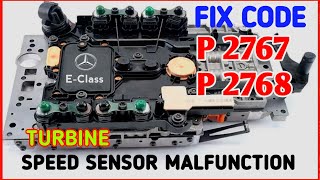
- Mercedes Benz E-Class , How to fix code p2767, p2768 turbine speed sensor malfunction ,
- How to Diagnose and Fix P2767 Engine Code - OBD II Trouble Code Explain

Conclusion
To sum it up, the P2767 code means your transmission isn’t getting the signal it needs from the input/turbine speed sensor B, which can lead to shifting problems and higher fuel use. It’s a moderate to high-risk issue-definitely not something to ignore. Start with the simple stuff: check the wiring and connectors, then test the sensor itself. Most of the time, fixing or replacing the sensor or repairing the wiring will solve the problem. Don’t put this off, because the risks just aren’t worth it. If you’re not comfortable with the diagnosis, it’s best to have a professional take a look. That way, you’ll keep your car running safely and avoid bigger headaches down the road.
 4899
4899 5 minutes of reading