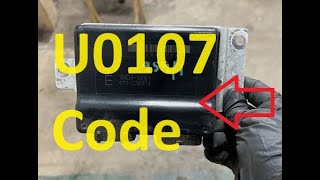
Let me break down what the U0107 code means for you. This code stands for “Lost Communication with Throttle Actuator Control Module.” In plain English, your car’s computer system is trying to talk to the throttle actuator control (TAC) module-which is basically the part that tells your engine how much to open the throttle based on your gas pedal input-but it’s not getting any response. The TAC module uses information from sensors on the throttle and the accelerator pedal to control how much air goes into the engine. All of this communication happens over the vehicle’s data network, called the CAN bus. If the TAC module can’t send or receive messages, the car’s computer gets worried and throws this code. This is a pretty important system, since it directly affects how your engine responds when you press the gas pedal.
DTC U0107
 4063
4063 6 minutes of reading
Common Causes of U0107
From my time under the hood, I can tell you the culprits behind a U0107 code are usually pretty consistent. Here’s what I most often see:
- Issues with CAN bus wiring-think of this as the main highway all your car’s computers use to chat. If there’s a damaged wire, corrosion, or a short, the message just won’t get through.
- Weak or dying battery-believe it or not, a simple low battery or a bad connection at the terminals can make modules drop offline and stop communicating.
- A faulty throttle actuator control (TAC) module-sometimes these just quit, no matter how well you treat your car.
- Trouble with the wiring to the TAC module-broken wires, loose plugs, or crusty connectors are all fair game here.
Honestly, most U0107 codes come back to wiring or connection issues, but I’ve chased down every one of these causes at one point or another.
Symptoms and U0107 Engine Code
Wondering what you’ll notice if your ride throws a U0107 code? Here’s what’s popped up most often in my experience:
- The check engine light almost always jumps to life.
- Sometimes you’ll see a special throttle warning light glowing on the dash.
- One of the most frustrating signs-a dead gas pedal. You press it, and nothing happens.
- Some cars get stuck in what we call “limp mode,” where you barely get enough power to crawl off the road.
If you’ve lost throttle response, don’t ignore it. That’s a clear sign you need to get this sorted out ASAP.

Diagnosis Process for OBD2 Code U0107
When a car rolls into my bay with a U0107 or gm dtc u0107, I always follow a proven process:
- Start with the battery. Check that it’s fully charged and the terminals are snug and clean. You’d be amazed how many electrical gremlins trace back to a weak battery.
- Check the fuses that power the throttle actuator and engine control modules. Even a single blown fuse can shut down communication.
- Move on to the wiring-inspect every inch for damage, corrosion, or loose connectors at the TAC module and along the harness. Here’s a pro-tip: have someone gently wiggle the wires while you watch for the code to clear or systems to come back online.
- If nothing turns up, I plug in a scan tool and see if the TAC module even appears on the network. If it’s missing, it’s time to break out the multimeter and check for power and ground right at the module.
- If you’ve got good power, ground, and wiring but the module still ignores you, odds are you’ve got a dead TAC module on your hands.
Double-check every connector before you swap out parts. A loose plug is a simple fix-but if you miss it, you’ll chase your tail and waste money.

Avoiding Common U0107 Trouble Code Mistakes
A classic mistake I see? Folks jump straight to swapping out the TAC module without checking the basics. Battery voltage, blown fuses, or crusty connectors are often the root cause. It’s easy to get tunnel vision and overlook a bad ground or a corroded plug-especially if you’re working in wet climates. My advice: always rule out the simple stuff before you start spending money on new parts. You’ll save yourself time, frustration, and a chunk of change.

How Serious is DTC U0107?
Don’t make the mistake of brushing this one off. When your car can’t talk to the throttle actuator, you’re flirting with disaster-no throttle means no get-up-and-go, and sometimes, you won’t be able to move the car at all. Limp mode might let you limp home, but you’re running on borrowed time. Ignore this, and you risk getting stranded somewhere inconvenient-or worse, damaging your control modules or wiring. My advice? Treat this as a top priority repair.
Effective U0107 Code Repair Solutions
Here’s what’s worked for me and what official repair steps usually call for:
- Track down and fix any damaged CAN bus wires or connectors between the TAC module and the rest of the system. Don’t cut corners-sometimes it’s just a tiny nick or a bit of green corrosion hiding in a connector that’s causing all the trouble.
- Give your battery some love. Clean the terminals, check the cable tightness, and if the battery’s on its last legs, replace it. Don’t underestimate how much havoc a weak battery can cause with modern electronics.
- Swap out any blown fuses linked to the throttle or engine control systems. Easy fix, but easy to miss.
- Once you’re sure everything else checks out, and the TAC module still isn’t responding, replace it-and make sure to follow your manufacturer’s procedure for programming it if that’s required. Some cars won’t play nice with a new module until it’s properly set up.
Every make and model can have its own quirks, so always double-check the specifics for your vehicle before diving in.
Conclusion
Bottom line: when you see a U0107 or gm dtc u0107 code, your car’s computer has lost touch with the throttle actuator control module. That’s not just a minor hiccup-it’s a serious glitch that can leave you stuck and unable to hit the gas. My advice? Start with the basics-battery, fuses, wiring-before you shell out for new modules. Don’t put off repairs; the risks are real, and you don’t want to get stranded. Careful diagnostics and methodical troubleshooting are your best friends here. Tackle each step, fix what’s really broken, and you’ll be back on the road with confidence-no guesswork, no unnecessary expense.