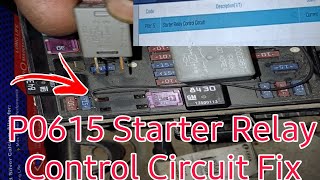
When you see code P0615 pop up, it’s your vehicle’s way of telling you there’s trouble in the starter relay circuit. The PCM-the car’s computer-has picked up on something fishy with the electrical path that should send juice to the starter relay. Let me put it in shop talk: The starter relay acts like a beefy switch, bridging the gap between your battery and the starter motor when you twist the key. You’ve got the ignition switch, some wiring, and sometimes a safety switch (like a clutch or neutral safety switch) all in that loop. If anything fails-be it a tired relay, crusty wiring, or a stubborn starter-the PCM flags it with this code. In my experience, chasing down a P0615 means rolling up your sleeves and checking every link in that chain.
DTC P0615
 5898
5898 5 minutes of reading
Causes of obd2 code P0615
From what I’ve seen in the shop and what the official manuals say, the most common reasons for a p0615 code are:
- Starter relay failure - This is the part that most often goes bad. Relays can wear out over time or get stuck.
- Starter motor failure - Sometimes the starter itself is the culprit, especially if it’s old or has seen a lot of use.
- Wiring issues - Corroded, damaged, or loose wires and connectors in the starter circuit can break the connection.
- PCM failure - Rare, but possible. If the computer that controls the system has a fault, it can trigger this code.
In my experience, it’s usually the relay or the wiring, but I never rule out the starter itself, especially on higher-mileage vehicles.
Symptoms of P0615 engine code
When this code pops up, here’s what you’re likely to notice:
- The check engine light comes on - That’s your first warning sign.
- The engine won’t crank - You turn the key and nothing happens, or you just hear a click.
- The engine struggles to start - Sometimes it’ll try to turn over, but it’s weak or inconsistent.
If you’re experiencing any of these, especially if the car won’t start at all, it’s time to take action. Don’t ignore it, or you could end up stranded.

Diagnosis of P0615 trouble code
When I’m faced with a p0615, I stick to a tried-and-true routine:
- I always start by checking the battery-make sure it’s holding a full charge and the terminals are clean and snug. Low voltage is a sneaky troublemaker.
- Next, I’ll have someone turn the key while I listen for the starter relay clicking. No click? That’s a red flag right there.
- I get my hands dirty inspecting every inch of wiring and all the connectors around both the relay and the starter. Look for green fuzz (corrosion), broken wires, or anything loose. Here’s a pro tip: have someone turn the key while you poke around with a test light or voltmeter at the relay and starter pins.
- If the wiring checks out, I’ll swap the starter relay with a known good one-sometimes you get lucky, and that’s all it takes. If the car fires right up, you’ve nailed it.
- If the relay’s good, I’ll test the starter motor by jumping it right at the terminals (carefully, of course-don’t skip safety). If it won’t spin, you’ve likely found your bad part.
- Only after all that do I start thinking about the PCM. Trust me, it’s almost never the computer, but you can’t rule it out until you’ve checked everything else.
And don’t forget the neutral or clutch safety switch-more than once, I’ve found that little guy was the real culprit.
Common Mistakes when fixing obd code P0615
I’ve seen a few common slip-ups when folks try to fix this code:
- Replacing the starter or relay without checking the wiring first. A loose or corroded connector can mimic a bad part.
- Overlooking the battery condition. A weak battery can cause all sorts of starting issues and false codes.
- Ignoring the safety switches (neutral or clutch). If these aren’t working, the starter circuit won’t complete.
- Assuming the PCM is bad without ruling out everything else. PCM failures are rare compared to relay or wiring problems.
It’s always best to start with the simple stuff before spending money on parts you might not need.

Seriousness of P0615 code issues
I can’t stress this enough-don’t shrug off a P0615. If your car refuses to start, you’re not going anywhere. Even if it’s an on-and-off problem today, it can leave you stranded without warning. Keep cranking with a bad circuit, and you’re risking fried relays, toasted wiring, or a burnt-out starter motor. Worst-case scenario? You overload the PCM, and that’s a wallet-buster of a fix. My advice: fix it now and avoid a roadside headache later.
Repair options for dtc P0615
When it comes to fixing a p0615, I’ve found these solutions get the job done:
- Swap out the starter relay if it’s shot. Nine times out of ten, this is your quick win.
- Chase down and repair any sketchy wiring or connectors-don’t forget to clean off that nasty corrosion.
- If the starter motor fails a jump test or looks worn out, it’s time for a replacement.
- If the neutral or clutch safety switch is acting up, fix or replace it to restore the circuit.
- PCM replacement or reprogramming is a last resort, and I only go there once every other possibility is off the table.
Double-check everything before you button up. You’d be surprised how often a missed wire brings the problem right back.
Conclusion
Bottom line-P0615 tells you your starter relay circuit’s on the fritz, and you need that system working if you want to get anywhere. In my shop, the usual suspects are a faulty relay, worn starter, or gremlins in the wiring, so I always start there. Don’t put it off; this is the kind of problem that’ll leave you stranded or cause a domino effect of damage if ignored. Start with the basics-battery, wiring, relay, and starter-knock out what’s bad, and you’ll be back behind the wheel with confidence.